
Amazon PPC and Amazon Ads – How Campaigns Work and How to Get Started
In this article, we show how Amazon Ads truly work, when they make sense, and when they only lead to wasted budget. We explain the mechanics of the PPC system, help you understand the relationship between ads and SEO, and demonstrate how to get started in a controlled manner – without chaos and costly mistakes.
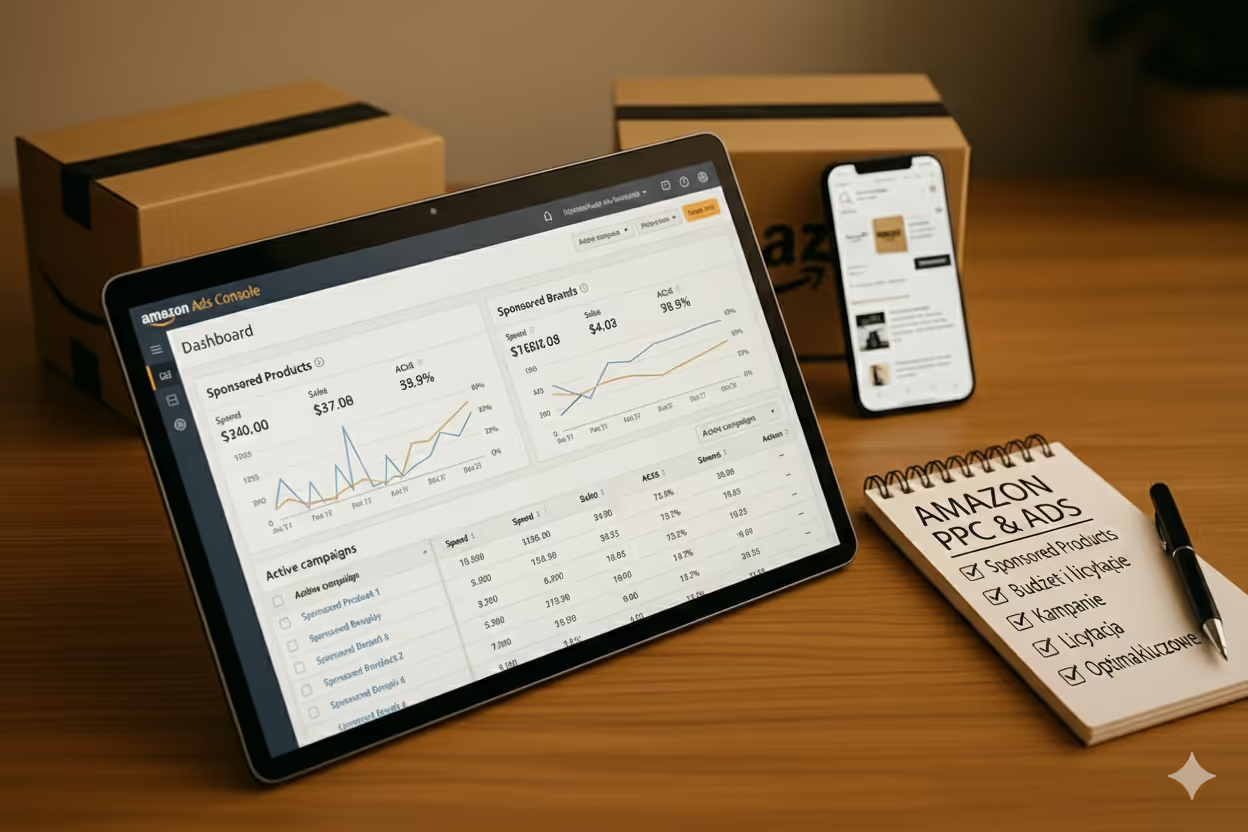
Why Amazon PPC Ads are Crucial in 2026
Just a few years ago, you could launch a good product on Amazon at a reasonable price and expect sales to "take off on their own." Today, that scenario is increasingly rare. Competition is fiercer, logistics and advertising costs are higher, and Amazon much more quickly rewards listings that generate real sales and data.
PPC ads have become crucial not because Amazon wants to earn more from advertisers, but because are the simplest way to provide signals to the algorithm, which it needs to evaluate a new or developing offer.
Why it's difficult to launch on Amazon today without ads
A new product on Amazon starts with very little data. The algorithm doesn't yet know:
- how well the offer converts,
- which keywords it should appear for,
- whether users actually purchase after landing on the listing.
Without ads, the "learning" process is slow and often haphazard. PPC allows this process to be accelerated by directing traffic exactly where we want it and collecting data that would typically not exist without paid exposure. In practice, this means that ads are often the only real way to move beyond the "invisible product" stage.
The Role of PPC in Gaining Initial Sales and Data
Initial sales on Amazon are important not only financially. They build:
- sales history,
- initial reviews,
- conversion and user behavior data.
PPC ads allow these sales to be generated faster and in a controlled manner. Thanks to them, we see which keywords sell, which only generate clicks, and where the offer actually falls short – whether due to price, photos, or messaging. Without PPC, this information would take months to gather, or often not at all.
PPC as an Accelerator for SEO and Organic Rankings
Amazon PPC does not operate in a vacuum. Well-managed advertising campaigns have a direct impact on organic visibility, though not in a "magical" way. Ads don't automatically boost rankings, but they help the algorithm more quickly understand which queries an offer should appear for.
If users click an ad, buy the product, and don't return it en masse, Amazon receives a clear signal that the offer matches the purchasing intent. This is precisely why PPC often acts as an SEO accelerator, especially for new products or when entering a new market.
In 2026, effective selling on Amazon is increasingly less about choosing "either SEO or ads." In practice, sellers who treat PPC and SEO as one cohesive system are the ones who win.
What Amazon Ads Are and How the Advertising System Works
Amazon Ads is Amazon's internal advertising system, whose goal is not to generate traffic "for traffic's sake," but rather maximizing sales on the platform. This is a key difference compared to Google Ads or Meta Ads. Amazon doesn't sell user attention – it sells access to a customer who is already in buying mode.
For sellers, this means one thing: Amazon Ads work best when they are embedded in a real purchasing process, rather than treated as a traditional marketing campaign.
What Amazon Ads is in practice
Amazon Ads is a collective term for advertising formats that allow you to promote products and brands directly on Amazon. These ads appear, among other places:
- in search results,
- on product pages (your own and competitors'),
- in recommendation sections,
- within the Amazon ecosystem outside the marketplace (for selected formats).
The most important thing, however, is that Amazon Ads are closely linked to product offers, not with abstract creatives or landing pages. An ad always leads to a specific product or set of products.
Where Amazon PPC Ads are Displayed
From a user's perspective, Amazon PPC ads are often almost indistinguishable from organic results. And this is no accident. Amazon deliberately integrates ads into the natural shopping flow to avoid disrupting the user experience.
The most common ad display locations are:
- top and middle sections of search results,
- product pages (the "Sponsored products related to this item" section),
- competitor listings,
- category pages.
For sellers, this means that ads don't compete for user attention, but rather compete directly with other offers, often very similar in price and functionality.
CPC Model and Ad Auction – What Really Determines Impressions
Amazon Ads operates on a CPC (cost per click) model, meaning we only pay when a user clicks an ad. The impression itself does not generate a cost. However, this is only a superficial description of the mechanism.
In practice, three main factors determine whether an ad is displayed:
- CPC bid,
- ad relevance to the query,
- offer quality (including conversion, sales history, availability).
This is important because it means that the highest bid doesn't always win the auction. Amazon has an interest in the user buying a product, not just clicking an ad. Therefore, offers that convert well and are relevant to the query can often win auctions with a lower cost-per-click.
Why Amazon Ads works differently than Google Ads and Meta Ads
Although Amazon Ads may resemble other advertising systems at the interface level, its operational logic is entirely different. Google and Meta focus on informational or entertainment intent, which is then later attempted to be converted into sales. Amazon starts precisely where other platforms end.
An Amazon user:
- looks for a product, not inspiration,
- compares offers, not brands,
- makes a purchasing decision faster and more rationally.
That's why Amazon PPC ads are closer to sales than traditional marketing. A well-configured campaign doesn't need to "convince" the user, but rather show them the right offer at the right time.
Understanding this difference is crucial. Without it, it's easy to transfer bad habits from Google Ads or Meta Ads and treat Amazon PPC as just another performance channel. In practice, Amazon Ads is more of a sales tool than a marketing tool – and that's where its strength lies.
Types of Amazon PPC Campaigns
Amazon Ads offers several campaign types, but in practice not all are needed at every stage of sales. One of the most common mistakes is trying to launch everything at once, without understanding the purpose of each format and what data it can provide.
In this chapter, we show how different types of Amazon PPC campaigns differ and when they actually make sense.
Sponsored Products – the foundation of sales on Amazon
Sponsored Products is the most important and most frequently used advertising format on Amazon. It promotes specific product offers and displays them in search results and on product pages.
It's worth starting with Sponsored Products because:
- lead directly to sales,
- generate data on keywords and user behavior,
- have the greatest impact on offer visibility.
In practice, most sales from Amazon PPC ads come from this format. Sponsored Products work well for launching new products, scaling bestsellers, and defending your own listings against competitors.
Sponsored Brands – building brand visibility
Sponsored Brands is a format that promotes a brand, not a single product. These ads typically appear at the top of search results and lead to:
- a Brand Store,
- pages with selected products,
- a dedicated landing page on Amazon.
This type of campaign makes sense when:
- you sell under your own brand,
- you have several related products,
- you want to increase brand awareness and control over the customer journey.
For new sellers, Sponsored Brands are often not a priority. Without a cohesive brand and a sensible product portfolio, it's difficult to extract real sales value from them.
Sponsored Display – remarketing and competition
Sponsored Display is the most flexible, yet also the most "marketing-oriented" format in Amazon Ads. It allows you to display ads:
- to users who previously viewed products,
- on competitors' product pages,
- outside Amazon, within the Amazon ecosystem.
This format works best as a complement, not a starting point. It is particularly useful for:
- remarketing,
- defending listings from customer poaching,
- strengthening brand visibility with a larger budget.
For new accounts, Sponsored Display is often too expensive and difficult to control. Without solid data and stable conversion, it's easy to burn through your budget here.
Which campaigns to choose for launch and which for later
For most sellers, the optimal sequence is as follows:
- starting with Sponsored Products,
- sales and campaign structure stabilization,
- gradual implementation of Sponsored Brands,
- supplementing efforts with Sponsored Display campaigns.
This approach allows you to first build a database and sales foundation, and only then invest in formats that require greater account maturity and budget.
Amazon PPC is not about using all available tools, but about conscious selection of those that support the current stage of sales development. The better we understand this stage, the easier it is to avoid chaos and unnecessary costs.
Automatic vs. Manual Campaigns
One of the first choices when launching Amazon PPC ads is whether to start with automatic or manual campaigns. In practice, this question is poorly framed. Combining both types yields the best results, but only if each of them plays a clearly defined role.
Amazon designed these campaigns not as alternatives, but as tools for different stages of working with data and sales.
How an Automatic Campaign Works
In an automatic campaign, Amazon decides for which queries and competitor products to display ads. The algorithm analyzes the listing, category, sales history, and user behavior, then selects the targeting itself.
For a seller, this means one thing: an automatic campaign is primarily a data collection tool. It shows:
- for which phrases the product actually sells,
- which queries generate clicks without sales,
- in what context competitor offers capture traffic.
This is not a campaign meant to be perfectly profitable from day one. Its purpose is to provide information that cannot be obtained otherwise, especially at the beginning.
What a Manual Campaign Is For
A manual campaign gives full control over where and for which queries an ad is displayed. This is where we decide:
- which keywords are targeted,
- in what match type (broad, phrase, exact),
- which competitor products we want to target or avoid.
Manual campaigns are the foundation of scaling and optimization. It is within them that:
- stable sales are built,
- controls costs,
- cuts unprofitable queries.
In practice, manual campaigns are responsible for the largest portion of profitable PPC sales – provided they are based on data, not guesswork.
Why It's Best to Combine Both Campaign Types
Automatics and manual campaigns serve different functions. Automatics discover potential, while manual campaigns leverage it. When we try to use only one type of campaign, problems usually arise:
- automatic campaigns alone lead to a lack of cost control,
- manual campaigns alone limit growth and scale.
The most common and healthiest working model is for an automatic campaign to serve as a research backend, with effective phrases gradually being transferred to manual campaigns where they can be precisely managed.
Common Mistakes When Choosing Campaign Types
Many sellers abandon automatic campaigns too quickly, deeming them "unprofitable." The problem is that evaluate them using the wrong criteria. Automatics don't always have a low ACOS, but they often provide crucial data without which manual campaigns won't perform well.
Another extreme mistake is leaving everything to automated systems without further intervention. This is the easiest way to burn through your budget and lose real control over scaling.
Amazon PPC is not about choosing one "better" campaign type. It's about understanding when a given campaign should generate profit, and when it should gather data. Only this approach allows for building a stable and predictable advertising system.
Amazon PPC Campaign Structure – How to Do It Right from the Start
A good Amazon PPC campaign structure is not an add-on or a cosmetic detail. It's the foundation that determines whether campaigns can later be optimized, scaled, and genuinely evaluated for profitability. A poorly designed structure quickly leads to data chaos and decisions made "by gut feeling."
Amazon offers great flexibility in campaign construction, but this doesn't mean every structure makes sense. On the contrary, the simpler and more logical the initial structure, the better it performs in the long run.
Campaign → Ad Group → Keywords and Targeting
The basic hierarchy in Amazon Ads is always the same: campaign, ad group, and targeting. In practice, this means that:
- a campaign should be responsible for the goal and budget,
- an ad group organizes products and targeting type,
- keywords and competitor ASINs are the lowest level of control.
Many sellers make the mistake of mixing these levels. When a single campaign contains different goals, products, and traffic types, control over costs and performance analysis is quickly lost.
One SKU or Multiple SKUs in One Campaign
To start, it's best to adopt a simple rule: one campaign – one product or a very narrow group of variants. This makes it easier to:
- assess real profitability,
- adjust bids,
- understand what actually works.
Combining many inconsistent products in one campaign might seem like a time-saver at first glance, but in practice, it complicates analysis and leads to unnecessary compromises. Scaling such a structure later becomes costly and time-consuming.
Match Types: Broad, Phrase, and Exact – When and Why
Keyword match types determine how broadly Amazon interprets user queries. Each has a different application and should not be treated interchangeably.
Broad is used for discovering new queries and testing potential. Phrase allows for narrowing traffic while maintaining flexibility. Exact provides the most control and cost stability. The best structures separate these match types into individual ad groups or even campaigns, allowing for precise control over bids and budget.
How Not to "Kill" a Campaign with a Bad Structure
The most common problem isn't a lack of knowledge about the tools, but rather excessive complexity at the start. Creating elaborate structures without data leads to situations where:
- campaigns don't gather enough clicks,
- optimization is based on guesswork,
- decisions are delayed or incorrect.
A good Amazon PPC campaign structure should be simple enough to quickly generate data and flexible enough to evolve with sales growth. In practice, it's better to start with a simple model and expand it consciously, rather than creating a complex system from the outset that may never work as intended.
Start Selling on Amazon Confidently and Effectively
You don't have to do everything yourself. We'll help you through every stage — from listing your first products and optimizing offers, to A+ Content, SEO, and scaling sales across Europe.
How to Set Up Your First Amazon PPC Campaign Step-by-Step
The first Amazon PPC campaign rarely determines sales success, but it very often determines whether the budget will be used wisely. Therefore, the goal should not be an "ideal setup," but rather a safe start that allows for data collection and doesn't discourage further work with ads.
Below, we describe a process that works well for both new accounts and initial campaigns in a new market.
What to Prepare Before Launching a Campaign
Before launching any ads, it's worth ensuring that your listing is ready to receive paid traffic. Ads won't fix fundamental issues; they'll only highlight them.
At the start, the following are crucial:
- a properly prepared title and main image,
- clear price and product availability,
- Prime or fast, predictable shipping,
- complete basic information on the product page.
If a listing doesn't convert organic traffic, there's no reason to expect it to convert paid traffic.
Choosing a Product for Advertising
Not every product is suitable for starting with PPC. It's best to choose an offer that:
- has a reasonable margin,
- is competitively priced within its category,
- has no significant presentation flaws.
A common mistake is advertising the entire catalog at once. It's much better to choose one or two products and focus on them, rather than spreading your budget and attention too thin.
Daily Budget – How Much to Set Initially
The starting budget doesn't have to be high, but it must be sufficient for the campaign to actually "learn." Too low a budget leads to ads displaying sporadically and data being random.
In practice, it's better to set a budget that allows for dozens of clicks per day rather than limiting the campaign to just a few clicks and drawing hasty conclusions. Amazon PPC is a data-driven system, and data requires volume.
CPC Bids – How Not to Burn Through Your Budget
At the start, there's no point fighting for the top positions. It's better to begin with moderate bids and observe where ads appear and how users behave.
It is important to:
- not to set extremely low bids that block impressions,
- not to bid aggressively without conversion data,
- give the campaign time to gather initial signals.
PPC on Amazon rarely works well in a "set it and forget it" mode, especially at the beginning.
First days of a campaign – what to expect
The first few days of a campaign are mainly for observation. Results can be unstable, and costs seemingly high. This is normal. The biggest mistake is turning off campaigns too quickly or nervously changing settings after just a few clicks.
Only after a few days and with a sufficient amount of data can conclusions be drawn and further steps planned. Amazon PPC rewards patience and consistency, not impulsive decisions.
Keywords in Amazon PPC – how to choose phrases and protect your budget
Keywords are the point where Amazon PPC ads most often start to "leak." Not because they are technically poorly chosen, but because they don't stem from real purchase data. Amazon PPC doesn't reward creativity in keyword selection, but rather precision and understanding of user intent.
Therefore, working with keywords in ads should be closely linked to how users actually search for products – both organically and in paid results.
Where to get keywords for Amazon PPC
The worst possible source of phrases for PPC campaigns is guesswork. The best is data. In practice, it's worth relying on three main sources:
- reports from automated campaigns,
- data from Amazon's search engine (search terms),
- analysis of competitor listings.
If the topic of keyword research on Amazon isn't yet well-organized, it's worth starting with solid fundamentals. We describe this exact process in a separate article:
👉 Amazon SEO and keyword research – how to find and use keywords
This material complements PPC work well, because the same phrases very often work simultaneously in SEO and ads.
The role of keyword research in PPC campaigns
In Amazon PPC, it's not about having as many keywords as possible, but about having the right keywords at the right stage. Broad phrases help gather data and build reach, but it's precise phrases that are most often responsible for sales.
Well-designed keyword research allows you to:
- separate informational phrases from strictly transactional ones,
- understand where the user is comparing and where they are buying,
- set different bids depending on intent.
Without this, PPC campaigns very quickly turn into a click generator without real sales.
Automated campaigns as a source of selling phrases
Automated campaigns act as "sonar" in PPC. They show which queries Amazon decides to display an offer for and which of them result in sales.
What we do with this data next is crucial. Phrases that generate sales should be:
- moved to manual campaigns,
- set to exact or phrase match,
- subject to separate bid and budget control.
This process closes the loop: automated campaigns collect data, manual campaigns earn.
Negative keywords – how to protect your ad budget
Negative keywords are one of the most underestimated elements of Amazon PPC. Without them, even well-chosen phrases can generate costly, unnecessary traffic.
Negative keywords allow you to:
- cut out queries that don't match the offer,
- block purely informational traffic,
- protect the budget from clicks without purchase intent.
This is especially important at the beginning, when every zloty spent on ads should provide data or sales. A lack of work with negatives is one of the most common reasons why PPC "doesn't work," even though campaigns are technically set up correctly.
PPC and SEO – a single keyword ecosystem
Keywords shouldn't live in two separate worlds: SEO and PPC. Ad data very often shows which phrases actually sell before a listing has a chance to rank organically for them.
Therefore, when working on an offer, it's worth combining:
- data from PPC campaigns,
- listing structure,
- content optimization for SEO.
If you're just building your entire sales presence on Amazon, a sensible next step is to look at listing and SEO as the foundation, and PPC as a tool to accelerate results:
How to Measure Amazon Ads Campaign Effectiveness
One of the biggest problems in Amazon PPC isn't a lack of data, but misinterpretation of data. Amazon provides dozens of metrics, but without context, it's easy to draw incorrect conclusions and make decisions that harm sales in the long run.
The effectiveness of Amazon Ads campaigns isn't about "pretty numbers in the dashboard," but about whether the ads genuinely support business goals: sales, scaling, and profitability.
Key Metrics in Amazon PPC – What to Really Measure
Amazon Ads provides many metrics, but in practice, a few of them are crucial.
ACOS (Advertising Cost of Sales) shows what percentage of revenue is consumed by advertising. It's one of the most frequently analyzed metrics, but also one of the most frequently misunderstood. A low ACOS doesn't always mean success, and a high one isn't always a problem – it all depends on the sales stage and margin.
ROAS (Return on Ad Spend) is the inverse of ACOS and can be more convenient for reporting, especially when ads are analyzed alongside other channels. However, by itself, it also doesn't provide a complete picture.
CTR (Click Through Rate) helps assess whether an ad is relevant to the query. A low CTR often indicates a problem with keyword selection or the offer, not necessarily with the budget.
Conversion Rate (CVR) shows what happens after a click. If an ad generates traffic but no sales, the problem usually lies with the listing, price, or logistics – not the campaign itself.
This is precisely why PPC analysis very quickly leads to conclusions that go beyond just ads.
When a campaign is "healthy" and when it's not
A healthy campaign isn't one that always has a low ACOS, but one that:
- achieves a clearly defined goal,
- delivers predictable results,
- can be optimized based on data.
A campaign is problematic when it:
- generates clicks without sales for an extended period,
- "eats up" the budget without impacting visibility or SEO,
- it's impossible to clearly define its purpose.
In practice, many campaigns are neither good nor bad – they are simply misjudged, because they are viewed through the wrong lens.
Why ACOS isn't enough to evaluate ads
ACOS shows the cost-revenue relationship, but doesn't show the impact of ads on the account's total sales. That's why, when scaling, TACOS, or the advertising cost in relation to total sales (paid and organic), becomes increasingly important.
If PPC campaigns support SEO, increase organic sales, and improve listing positions, then even a higher ACOS can make business sense. Especially for new products or when entering a new EU market.
In this context, ads must be analyzed together with other sales elements, such as logistics or Prime availability. If you want to better understand how these elements connect, it's worth checking out:
👉 Amazon Logistics: FBA, FBM, EFN, Pan-EU
How to interpret data, not just look at it
Numbers alone mean little without context. Therefore, when analyzing campaigns, it's always worth asking yourself:
- what the goal of this campaign was,
- at what stage of the product lifecycle it operates,
- whether it supports short-term sales or long-term visibility.
Only such an approach allows distinguishing between campaigns that genuinely "don't work" and those that simply haven't haven't had a chance to do their job.
If you feel that ads are generating costs but it's difficult to clearly assess their impact on sales, the problem is often not the campaigns themselves, but a lack of a holistic view of the data.
In such situations, a sensible step is often ad account and sales audit, which organizes metrics and goals - contact us
Amazon PPC Campaign Optimization – What to do after launch
Launching an Amazon PPC campaign is just the beginning, not the end of the work. In practice, results are determined by what we do with the campaign after collecting initial data. Without optimization, even a well-structured setup starts to lose effectiveness, and the budget gradually dissipates.
PPC optimization isn't about "twiddling knobs" daily, but about regular, data-driven decisions.
How often to optimize campaigns
One of the most common mistakes is making changes too frequently. Amazon Ads needs time to react to bid or structure modifications. On the other hand, a complete lack of reaction also leads to problems.
In practice:
- initially, analysis every few days is sufficient,
- after sales stabilize – once a week,
- with large budgets and scale – according to a set rhythm (e.g., weekly cycles).
The key is that every change had a specific reason, and wasn't a reaction to a single day of weaker results.
What to turn off and what to scale
Optimization begins with tidying up. Phrases and targeting that generate clicks without sales for an extended period usually won't improve "on their own." In such cases, it's worth considering:
- lower bids,
- add negative keywords,
- or turn them off completely.
On the other hand, phrases that sell consistently should be scaled gradually – by increasing bids or budget. It's important to do this in a controlled manner, observing the impact on margin and product availability.
Moving phrases from automatic to manual campaigns
This is one of the most important processes in Amazon PPC. Automatic campaigns uncover potential, but manual campaigns allow you to leverage it.
If a given phrase:
- generates sales,
- has a reasonable cost,
- is repeatable,
should be moved to a manual campaign, ideally with exact or phrase match. At the same time, it's worth excluding it from automatic campaigns to avoid campaigns competing with each other.
This process directly links PPC with SEO and offer optimization. Phrases that sell well in ads are very often worth using in the listing content as well. If you want to organize this area, the following article will be helpful:
👉 How to list a product and optimize an offer on Amazon
When to increase the budget and when to cut it
Increasing the budget only makes sense if the campaign:
- is profitable or meets a clearly defined goal (e.g., launch),
- is not limited by a low number of impressions,
- has a stable conversion rate.
Budget cuts are sometimes necessary when a campaign generates costs without impacting overall account sales. However, it's important to distinguish between strictly sales-driven campaigns and those that support SEO and visibility.
In this context, PPC is strongly linked to the entire Amazon sales strategy – from market selection to tax and operational issues. When scaling to multiple EU markets, it's especially important that ads are synchronized with the operational backend:
👉 VAT, OSS, and EPR on Amazon in the EU
Optimization as a process, not a one-time action
The best-performing Amazon Ads accounts are not those that had an "ideal start," but rather those that are regularly optimized and adapted to changing conditions: competition, prices, seasonality, and product availability.
Amazon PPC is an ongoing process. Campaigns that perform well today may require adjustments in a few months. The sooner you adopt this approach, the easier it will be to scale sales without chaos and sudden cost spikes.
How Amazon PPC supports Amazon SEO
The relationship between Amazon PPC ads and organic rankings is one of the most debated topics among sellers. On one hand, it's often said that "ads have no impact on SEO," while on the other, that "without PPC, you can't rank a product today." The truth lies somewhere in the middle, and it's worth understanding it well, as it dictates how campaigns should be run.
Amazon PPC is not a magic switch that automatically boosts an offer in organic results. However, it is a tool that accelerates the process of providing data to the algorithm needed to evaluate the offer.
What signals the algorithm considers
Amazon evaluates offers based on many factors, but the key ones are:
- relevance to user query,
- conversion rate,
- sales velocity and stability,
- product availability and order fulfillment quality.
PPC ads indirectly influence some of these signals. By directing traffic to a specific offer, they help assess how users react to a product in a particular search context. If clicks result in sales, the algorithm "learns" faster that the offer is relevant.
PPC as a keyword testing tool
One of the biggest practical advantages of PPC is the ability to test keywords in real-world conditions. In SEO, you often wait weeks or months to see the effects of listing changes. Ads allow you to check a phrase's potential almost immediately.
Phrases that:
- generate sales in PPC campaigns,
- have a reasonable cost,
- recur in the data,
are excellent candidates for strengthening within the listing content. This way, PPC and SEO begin to work as one system, rather than two independent channels.
Why PPC helps new products "get established" faster
A new product without sales history is a big unknown for the algorithm. Even a well-prepared listing might not gain organic visibility for a long time if it doesn't generate sales.
PPC helps shorten this stage by providing:
- initial clicks,
- initial sales,
- initial user behavior data.
This helps Amazon classify the offer faster and assign it to relevant queries. While it doesn't guarantee high rankings, it significantly increases the chances of breaking through in competitive categories.
Common mistakes in combining PPC and SEO
The biggest mistake is treating PPC as a substitute for SEO or vice versa. Ads won't compensate for a poor listing, and content optimization alone isn't enough in crowded search results.
Another common problem is the lack of data flow. If phrases that sell well in PPC are not utilized in SEO, the ad's potential is wasted. Conversely, optimizing a listing for phrases that don't convert in ads often leads to false conclusions.
PPC and SEO as one process
In 2026, effective selling on Amazon is increasingly less reliant on isolated actions. PPC and SEO are elements of the same process: building visibility, sales, and data.
Ads accelerate information gathering and assumption testing, while SEO allows for scaling results without proportionally increasing the budget. Only combining both approaches yields stable and predictable results.
Start selling on Amazon confidently and effectively
You don't have to do everything yourself. We'll help you through every stage — from listing your first products and optimizing offers, to A+ Content, SEO, and scaling sales across Europe.
Amazon Ad Budget and Costs – What it Really Costs
One of the first questions that arises with Amazon PPC is: "how much do I need to spend for it to make sense?" The answer isn't black and white, but it is possible to define reasonable frameworkthat protect against budget waste and unrealistic expectations.
Amazon ad costs are not arbitrary. They are a result of competition, category, product price, and offer quality. The sooner we understand this, the easier it will be to plan a budget that supports sales rather than burdens them.
What Amazon ads cost in practice
Amazon operates on an auction model, so the cost per click can vary significantly even within the same category. In some segments, clicks cost pennies, while in others, they cost several euros. The differences mainly stem from:
- number of active advertisers,
- average order value,
- level of price competition,
- seasonality.
Instead of asking "how much does a click cost?", it's better to ask: how much it costs to acquire a sale, because this metric determines the profitability of the campaign.
How to plan your initial budget
The initial budget should be sufficient for the campaign to collect data. Too low a budget means ads are displayed randomly, and conclusions are prone to significant error.
In practice, it's better to plan a budget that:
- allows for collecting several hundred clicks over a few weeks,
- does not threaten financial liquidity,
- is treated as an investment in data, not solely in sales.
At this stage, the goal is not a perfect ACOS, but to understand which phrases and products have the potential for further scaling.
Cost Differences Between Categories
Not all categories on Amazon are equally expensive for advertising. Products with high competition and strong demand usually require larger budgets, especially at launch. Niche categories, on the other hand, often allow for PPC testing at a lower cost, but also offer a smaller scale.
That's why budget planning should always consider:
- average product price,
- margin,
- expected sales volume.
Without this, even "cheap" clicks can turn out to be expensive for the business as a whole.
Why a Low ACOS Isn't Always Good
A low ACOS often looks good in reports, but it doesn't always mean the campaign is performing optimally. Very conservative campaigns can generate sales, but at the same time limit scale and visibility.
On the other hand, overly aggressive campaigns can increase sales, but at the expense of margin. The key is to find a balance between profitability and growth, rather than focusing on a single metric.
Costs as a Strategic Element, Not a Problem to "Cut"
Amazon PPC ads are only a cost when they don't support any goal. If they help build sales, test the market, or strengthen SEO, they become a strategic element, not a burden.
The best ad accounts don't aim to minimize spending, but for controlled growth, where costs are predictable and data-justified.
Most Common Mistakes in Amazon PPC
Most problems with Amazon PPC don't stem from a lack of tools or technical knowledge, but from incorrect assumptions at the start. Ads are often treated as a quick fix for sales problems, but in practice, they only highlight them. Below, we describe the mistakes we most frequently see in seller accounts – both for beginners and those with more experience.
Advertising a Weak or Incomplete Listing
This is the most common and simultaneously most expensive mistake. Ads drive traffic to an offer that isn't ready for sale. Poor photos, an unclear title, missing key information, or an uncompetitive price mean that clicks don't convert into orders.
In such a situation, the problem isn't PPC, but the sales foundation itself. Ads won't improve conversion; they'll only test it. If the result is poor, it's a signal to work on the product offering, not to "tweak" bids.
Lack of Negative Keywords
Many sellers focus solely on adding new phrases, forgetting to cut out those that don't make sales sense. A lack of work with negative keywords leads to a situation where the budget is gradually "eaten up" by informational or mismatched queries.
Negative keywords are one of the simplest ways to improve campaign efficiency without increasing the budget. Their absence almost always means unnecessary costs.
Scaling Campaigns Without Margin Control
The sight of growing sales from PPC can be very tempting. The problem begins when volume growth isn't accompanied by margin analysis. It sometimes happens that campaigns generate sales but actually reduce the overall profitability of the business.
Amazon PPC requires thinking not only in terms of revenue but also costs: advertising, logistics, commissions, and taxes. Without this, it's easy to fall into the trap of "selling more, earning less."
Turning Off Campaigns Too Quickly
One of the most destructive habits is evaluating campaigns after just a few clicks or one weak day. Amazon Ads needs data for a campaign to start performing predictably. Turning off campaigns too quickly constantly interrupts the algorithm's learning process.
Of course, not every campaign makes sense, but the decision to turn it off should stem from data analysis over an appropriate time horizon, not from emotion.
Treating PPC as the Sole Source of Sales
PPC is sometimes treated as the main sales engine, meant to "replace" SEO, a good product offering, or pricing strategy. This is a short-term and risky approach. Ads are effective when they support the entire sales ecosystem, not when they try to replace it.
The most stable accounts are those where PPC, SEO, product offering, and logistics are synchronized. When one of these elements fails, ads quickly expose it.
Lack of Clearly Defined Campaign Goal
Many campaigns operate without a clearly defined goal. It's unclear whether they are meant to sell, test the market, support SEO, or defend against competitors. As a result, they are difficult to evaluate, and optimization decisions are haphazard.
Every campaign should have a specific role. Only then do metrics like ACOS or ROAS start to make sense and lead to real business decisions.
How to Use AI in Amazon PPC
AI is increasingly appearing in the context of Amazon PPC ads, but in practice, it's easy to fall into two extremes: either treating AI as a magic solution that "does everything itself," or completely ignoring it. Both approaches are flawed. AI in PPC works best as a decision-support tool, not as a replacement for them.
Amazon Ads is a system based on data and repeatable processes – precisely where AI makes the most sense.
AI for Ad Data Analysis
The greatest value of AI in Amazon PPC lies in working with large datasets. Campaigns generate hundreds or thousands of rows in reports, which manual analysis is time-consuming and prone to errors.
AI can help with:
- detecting patterns in costs and conversions,
- identifying phrases that "spoil" results,
- comparing periods and trends, not just individual days.
This ensures that optimization decisions are based on a broader context, rather than intuition or a single metric.
AI in Building and Organizing Campaign Structures
With a larger number of products and markets, the problem is no longer just setting up campaigns, but maintaining a consistent structure. AI can support:
- creating logical campaign divisions,
- grouping phrases by intent,
- organizing accounts that have grown for years without a clear concept.
This is particularly useful when scaling sales or expanding into new markets, where manual copying of structures quickly leads to chaos.
AI in Bid and Budget Optimization
Bid automation is one of the most tempting areas for AI application. And indeed, within certain limits, it works well. AI can react faster to data changes and adjust bids based on historical results.
The problem arises when optimization occurs without business context. AI doesn't know:
- what the actual margin is,
- whether a campaign has a sales or testing goal,
- whether a given product is in the launch or maturity phase.
Therefore, automation should operate within clearly defined rules, rather than as a "free hand" for the system.
AI as Support, Not Autopilot
A hybrid approach yields the best results. AI:
- accelerates analysis,
- organizes data,
- suggests possible directions.
Human:
- sets strategy,
- defines goals,
- makes decisions that go beyond numbers.
In Amazon PPC, those who understand the product, market, and customer still win. AI can enhance this understanding, but it won't replace it. Treating AI as an autopilot usually results in losing control over costs and strategy.
A Realistic Approach to AI in Advertising
By 2026, AI will be a standard element of working with Amazon PPC, just as reports or automated campaigns are today. The advantage will go not to those who use the "most advanced tool," but to those who best combine technology with process and experience.
AI doesn't change the rules of the game in Amazon PPC. It changes the pace of work and the quality of decisions. And it's in this role that it offers the greatest value.
Amazon PPC Launch Scenarios
There isn't one "ideal" way to run Amazon PPC ads. How campaigns should be structured depends primarily on the sales stage, where the product or account is located. It's a mistake to copy strategies from other accounts without considering the business context.
Below, we describe the most common scenarios we encounter in practice, and the role PPC plays in each of them.
Starting from Scratch – New Account, New Product
This is the most demanding scenario. The product has no sales history, reviews, or data, and Amazon's algorithm doesn't yet know how to classify it. In such a situation, PPC primarily serves as a tool for gathering data and initial sales signals.
At this stage:
- automatic campaigns help discover actual user queries,
- manual campaigns test basic shopping phrases,
- the goal is not a low ACOS, but sales and visibility.
The most common mistake is expecting profitability too quickly. PPC during a launch is an investment in data that only starts to pay off in the following weeks.
Scaling Bestsellers
When a product is already selling organically and has a history, PPC changes its role. It stops being a "rescue" tool and becomes a growth lever.
In this scenario:
- manual campaigns take over most of the budget,
- bids are optimized for scale, not just cost,
- PPC supports maintaining organic rankings amidst growing competition.
Systemic thinking is crucial here. Scaling ads without controlling availability, logistics, or margins very quickly leads to operational problems.
Defending listings against competition
As sales grow, competition emerges, starting to advertise on your product pages. At this point, PPC serves a protective.
Ads:
- protect your own listings,
- limit competitors from taking over traffic,
- help maintain stable sales.
This is a scenario where ACOS can be higher, but the cost of not advertising might be even greater. A lack of listing defense often means a gradual loss of sales, even with a well-optimized offer.
PPC for expansion into new EU markets
Entering a new market (e.g., DE, FR, IT, or ES) is practically a repetition of the launch process, even if the product sells well in another country. The algorithm treats each market separately, and data doesn't always "transfer" automatically.
In this scenario, PPC:
- accelerates gaining visibility,
- allows testing local phrases and user behavior,
- shortens the time needed for initial sales.
It's a mistake to copy campaigns 1:1 from another market without adjusting bids, budgets, and purchasing intent. PPC during expansion should be treated as a market test, not a ready-made recipe.
One goal, different strategies
Each of these scenarios requires a different approach to budget, metrics, and optimization. The common denominator is one thing: PPC should always have a clearly defined role. Without it, it's hard to assess whether a campaign is working well or just "doing something."
Consciously adapting your PPC strategy to the sales stage is one of the biggest factors distinguishing accounts that grow steadily from those constantly putting out fires.
FAQ – frequently asked questions about Amazon PPC
Is Amazon PPC mandatory for selling on Amazon?
Formally no, but practically very often yes. In many categories, competition is so high that without ads, it's difficult to generate initial sales and the data the algorithm needs to evaluate an offer. PPC is not a regulatory requirement, but in practice, it has become one of the fundamental tools for launching and scaling sales, especially for new products and in new markets.
How much do you need to spend on Amazon PPC to see results?
There isn't one amount that guarantees results. The key is not how much you spend, but whether the budget allows for collecting meaningful data. A few clicks a day are usually not enough to draw conclusions. In most cases, a budget is needed that allows for testing phrases and user behavior for at least a couple of weeks. Only then does PPC begin to deliver real value.
Is it possible to sell on Amazon without ads?
Yes, but this usually applies to very specific situations: niche products, strong brands, or offers with a clear price advantage. In most categories, ads are now a part of market equilibrium. A lack of PPC often means ceding visibility to competitors, even if the listing is well-optimized.
How long should I test an Amazon PPC campaign before evaluating it?
Evaluating a campaign after one or two days is unreliable. Amazon needs time to collect data, and initial results can be random. In practice, a reasonable testing period is a minimum of several days of intensive impressions and clicks, and ideally, a couple of weeks of campaign operation. Only then can you talk about trends, not isolated deviations.
What's more important: a low ACOS or higher sales?
It depends on the campaign's goal. A low ACOS is important for profitability-focused campaigns, but for launches or scaling, sales, visibility, and data can be more crucial. Focusing solely on ACOS without context often leads to overly conservative campaigns that limit growth. In Amazon PPC, it's always best to define the goal first, and then select the appropriate metrics.
Do Amazon PPC ads directly affect organic rankings?
Not directly. Amazon doesn't "boost rankings" just because you pay for ads. However, PPC indirectly influences SEO by generating sales and data that the algorithm considers when evaluating offers. Well-managed campaigns can accelerate the process of gaining organic visibility, but they won't replace work on the listing itself.
Are automatic campaigns worse than manual ones?
No. Automatic campaigns serve a different role than manual ones. They are an excellent source of data and help discover phrases a seller might not choose themselves. Manual campaigns offer greater control and stability. The best results are achieved when both types of campaigns are used consciously and at the right time.
Does Amazon PPC work the same way in every EU country?
No. Each market has its own specifics: different user behaviors, different rates, different competition. Campaigns that work well in one country won't necessarily translate 1:1 to another market. Therefore, when expanding, PPC should be treated as a testing tool, not a ready-made scheme to copy.

